



Top 10 Churn Prediction Software Compared

Churn prediction software scores each customer on how likely they are to cancel, so your team can step in before the renewal date or the cancel button. This guide compares 10 tools on how they predict churn, who they suit, and what they cost, with pricing checked on each vendor’s own website in September 2026.
Table Of Contents
- How We Picked These Tools
- Churn Prediction Software Comparison Table
- How Churn Prediction Software Works
- 1. Churnfree
- 2. ChurnZero
- 3. Gainsight
- 4. Pecan AI
- 5. Pendo Predict
- 6. Optimove
- 7. Vitally
- 8. Planhat
- 9. Custify
- 10. HubSpot Service Hub
- How to Choose Churn Prediction Software
- FAQs
- Conclusion
How We Picked These Tools
Plenty of “churn” tools do something useful but never tell you which customer is about to leave. To make this list, a tool had to meet at least one of these criteria:
- It scores churn risk per customer or account. That can be a machine learning model, a configurable health score, or both.
- It acts on the risk. Alerts, playbooks, campaigns or a retention offer, so the score turns into a saved customer.
- It is actively sold today. We checked every vendor’s website in September 2026. Tools that shut down, pivoted away from churn, or merged into another product were removed.
That last point changed the list a lot compared with the 2024 version of this article. Akkio now sells AI tools to advertising agencies instead of general churn models, Upzelo has moved to loyalty and referral programs for ecommerce, Segment is a customer data platform that feeds prediction tools rather than predicting churn itself, and Churnly’s website was not responding when we checked. Totango rebranded as Odie in September 2026, so we left it out until the new product settles.
We also grouped the tools by approach, because the right choice depends more on your data and team than on feature lists:
- Customer success platforms (ChurnZero, Gainsight, Vitally, Planhat, Custify, HubSpot) combine health scores with CSM workflows. Best for B2B companies with account managers.
- Predictive AI platforms (Pecan AI, Pendo Predict) build machine learning models on your own data. Best when you have history and want a probability, not a rule.
- Marketing retention platforms (Optimove) score consumers and trigger campaigns. Best for B2C brands with large customer bases.
- Cancellation-point retention (Churnfree) acts on the strongest churn signal there is: a customer clicking cancel.
Churn Prediction Software Comparison Table
| Tool | Best for | Prediction approach | Starting price | Free trial |
|---|---|---|---|---|
| Churnfree | Subscription businesses on Stripe or Paddle Classic | Acts on cancel intent; exit feedback shows churn causes | $49/month | 14 days, no credit card |
| ChurnZero | B2B SaaS customer success teams | ChurnScore health scores plus ML “Success Insights” | Custom pricing | No public trial (demo) |
| Gainsight | Enterprise customer success | Health scorecards plus AI risk signals (Staircase AI) | Custom pricing | No public trial for Customer Success (demo) |
| Pecan AI | Analysts and RevOps without data scientists | No-code ML models on warehouse data | Custom pricing | No public trial (demo) |
| Pendo Predict | Product-led SaaS already on Pendo | ML on product usage plus CRM data | Custom pricing (add-on) | 30-day Pendo trial via sales; Predict by demo |
| Optimove | B2C brands, iGaming, retail, finance | Daily “Risk of Churn” score in five levels | Custom pricing | No public trial (demo) |
| Vitally | Scaling B2B customer success teams | Dynamic health scores plus Vitally AI | Custom pricing | Trial sandbox after demo |
| Planhat | B2B teams wanting CRM plus CS in one | Health scores from analytics, human and AI input | Custom pricing | No public trial (enquire) |
| Custify | SMB and mid-market B2B SaaS | Custom health scores plus CustifyAI churn risk | Custom pricing | No public trial (demo) |
| HubSpot Service Hub | Teams already running on HubSpot CRM | Rule-based health scores in the CS workspace | $90/seat/month + $1,500 one-time onboarding | Free HubSpot tools; CS workspace needs Pro |
Most tools in this category use custom pricing, and the quote usually depends on the number of customer accounts, users or events you track. Ask for a quote before a demo so you can rule out tools that don’t fit your budget early.
How Churn Prediction Software Works
Every tool on this list follows the same basic loop, even if the math differs.
1. Collect signals. The software pulls data from your product (logins, feature usage, seats used), billing system (plan, failed payments, downgrades), support desk (ticket volume, sentiment), surveys (NPS, CSAT) and CRM (renewal date, owner, contract value).
2. Score each customer. There are two ways to do this:
- Rule-based health scores. You decide the weights, for example “minus 20 points if logins drop 50% in 30 days, minus 10 for an open high-priority ticket.” They are easy to understand and quick to set up, but only as good as your assumptions. HubSpot, Custify and Vitally lean this way, with AI features on top.
- Machine learning models. The tool learns from customers who already churned and finds the patterns that preceded it. Common algorithms include logistic regression, random forests and gradient boosting. Pecan AI, Pendo Predict, Optimove and ChurnZero’s Success Insights work this way. You get a probability instead of a points total, but you need enough churned customers in your history for the model to learn reliable patterns.
3. Explain the risk. A score alone does not tell a CSM what to do. Good tools show the top drivers, for example “usage of the reporting feature fell 60%,” so the outreach is specific.
4. Trigger an action. Alerts in Slack or Salesforce, a CSM task, an email journey, an in-app message, or a retention offer when the customer tries to cancel.
5. Measure and retrain. Compare predicted risk with who actually churned, then adjust weights or retrain the model. If “at-risk” customers renew at the same rate as “healthy” ones, the score is not working.
Prediction only pays off when step 4 happens. That is why many teams pair a prediction tool with a cancel flow that catches the customers the model missed. For a deeper look at the modeling side, read our guide to customer churn prediction.
1. Churnfree
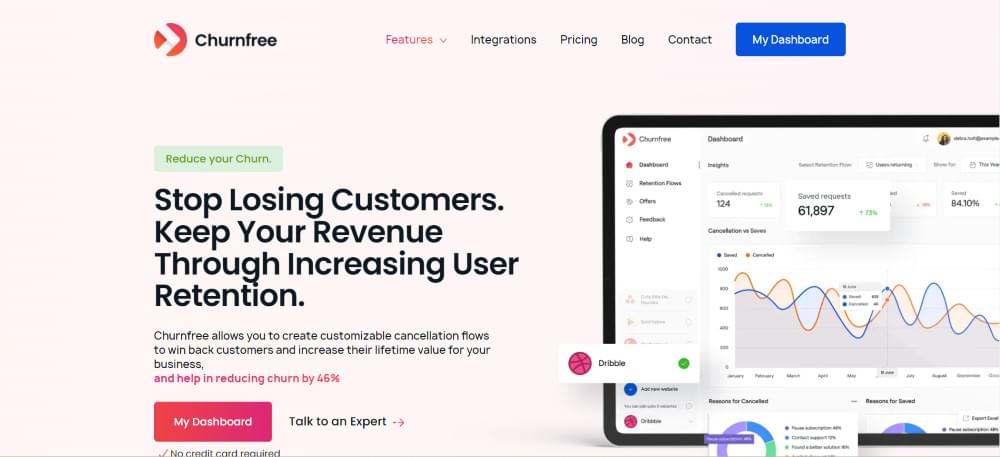
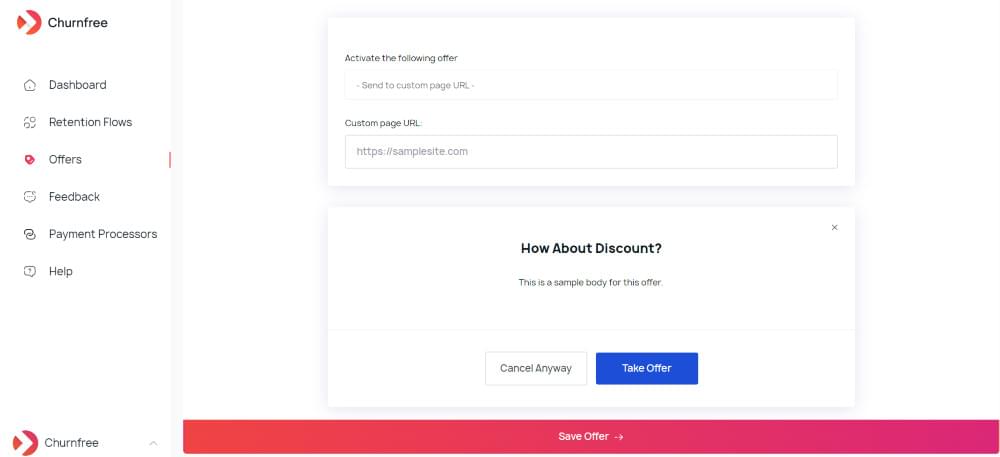
To be clear up front: Churnfree does not build a predictive model. It works at the moment churn stops being a prediction and becomes a fact, when a customer clicks cancel. Instead of letting that click end the subscription, Churnfree shows a customizable cancellation flow that asks why the customer is leaving and responds with the offer you set for that reason: a discount, a subscription pause, or a link to a page you choose, such as a help or contact page.
We put it first because it covers the gap every prediction tool leaves. Even the best model misses customers, and many small and mid-sized subscription businesses do not have the data volume to train one. The exit feedback Churnfree collects also gives you a clean, labeled dataset of churn reasons, which is exactly what you need to analyze customer churn causes and later tune a health score.
Catch the customers your model misses. Try Churnfree free for 14 days and put a cancellation flow with pause options, retention offers and exit feedback in front of every customer who clicks cancel. No credit card required.
Key Features
- Retention flows: Build cancellation flows without code and match them to your site.
- Offers: Match one offer to each cancellation reason: a Stripe coupon, a Paddle Classic percentage discount, a pause or a link to a page you choose.
- Subscription pause: Let customers pause instead of cancel.
- Client feedback: Collect the reason behind every cancellation attempt.
- Analytics dashboard: Track saves, cancellations and feedback in one view.
- Multiple websites: Manage churn for several products or brands from one account.
- Payment integrations: Stripe and Paddle Classic are live (Paddle Billing is not supported), and flows also work without a specific payment processor.
Pros
- Live in minutes with no developer work, and a 14-day free trial with no credit card.
- Acts on the highest-intent churn signal, so every save is measurable.
- Exit feedback turns into churn-reason data you can use in any other tool.
- Public, low entry price compared with every other tool on this list.
Cons
- No predictive risk score, health score or CSM workspace. It does not warn you before a customer decides to cancel.
- Native billing integrations are limited to Stripe and Paddle Classic today. Paddle Billing is not supported, and Recurly and Braintree are listed as coming soon.
Pricing
Pricing is listed on the Churnfree homepage:
- Basic: $49/month for 1 website, 1 active workflow and 5 dynamic offers.
- Professional: $99/month for 3 websites, 5 workflows and 25 offers.
- Business: $199/month for 7 websites, 12 workflows, 50 offers and premium support.
- Enterprise: Custom quote.
All paid plans include a 14-day free trial.
2. ChurnZero
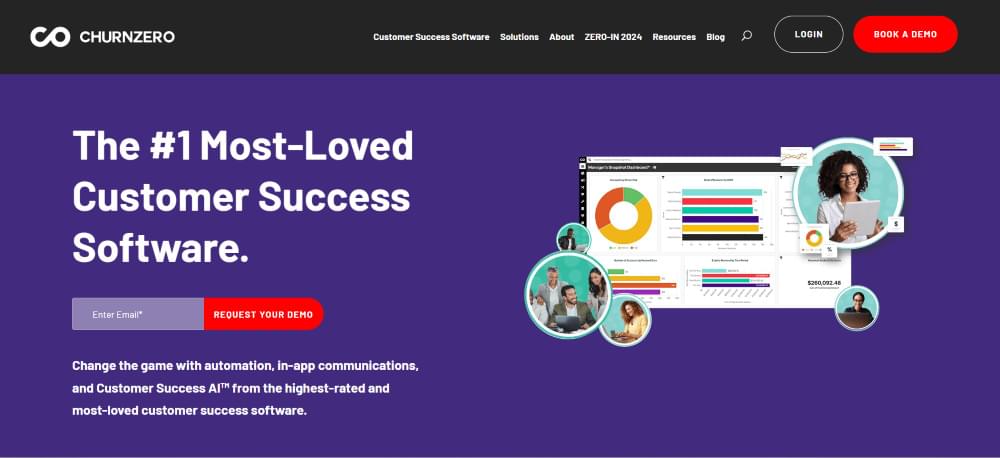
ChurnZero is a customer success platform built for B2B subscription companies. Its churn prediction has two layers. The ChurnScore is a configurable health score that combines product usage, support activity, renewal history and other inputs, and it can trigger alerts, plays and journeys automatically. Success Insights adds machine learning: it analyzes historical customer data to identify at-risk accounts and the factors behind the risk.
On top of that, the Renewal and Forecast Hub helps teams forecast retention and growth, and AI features such as Snapshot AI summarize an account’s health, usage and communications in one view.
Pros
- Combines a transparent health score with an ML model, so you can compare both.
- Strong automation: scores can launch plays, in-app messages and email journeys.
- Renewal forecasting ties churn risk to revenue planning.
Cons
- Built for teams with dedicated CSMs; heavy for a small team with no CS function.
- Setup takes real effort, since the score is only as good as the data you connect.
- No public pricing or self-serve trial.
Pricing
Custom pricing. ChurnZero does not publish prices on its website; you request a demo to get a quote.
3. Gainsight
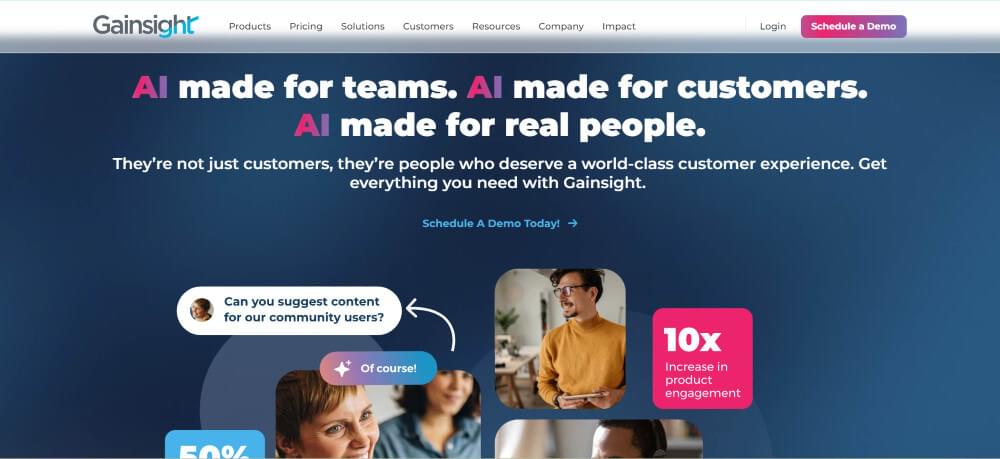
Gainsight is one of the longest-established customer success platforms and a common choice for large B2B companies. Its Customer Success product gives each account a health scorecard alongside usage and support history. Staircase AI, now part of Gainsight, reads emails, calls and other interactions to detect risk signals, which Gainsight says surfaces at-risk accounts months before renewal. Pre-built risk, handoff and expansion agents flag early churn signals and suggest next steps.
Pros
- Deepest feature set for health scoring, renewals and CS operations.
- AI risk signals from conversations, not only product data.
- Scales to very large account bases and complex org structures.
Cons
- Long implementation and a learning curve; many companies use a Gainsight admin or partner.
- Priced for enterprise budgets.
- No self-serve trial for the Customer Success product.
Pricing
Custom pricing. The Gainsight pricing page lists Customer Success Essentials and Enterprise editions, both marked “Request Pricing.”
4. Pecan AI
Pecan AI is a predictive analytics platform for teams that want a real machine learning churn model without hiring data scientists. You connect historical, event-level data from a warehouse such as Snowflake, BigQuery, Redshift or Databricks, or upload CSV or Excel files, then describe what you want to predict. Pecan’s AI agent prepares the data and builds the model. Pecan says a first model is typically ready in under a day.
Predictions are pushed back into your CRM, marketing tools or BI dashboards, so marketing and CS teams can act on them. The same platform also predicts lifetime value, upsell and win-back likelihood.
Pros
- A true ML churn model built on your own data, with little coding.
- Works for both B2B and B2C, subscription or repeat purchase.
- Predictions flow into Salesforce, marketing platforms and BI tools.
Cons
- You need clean historical data and someone who understands it, typically an analyst.
- It predicts but does not run CS workflows; you still need a tool to act on the scores.
- No public pricing.
Pricing
Custom pricing. The Pecan pricing page lists Starter (2 monthly prediction batches, 500M rows), Team (10 batches, 2Bn rows) and Business (custom batches, 5Bn rows) plans, all with “Talk to sales” instead of a price.
5. Pendo Predict
Pendo Predict is an AI add-on for Pendo, the product analytics and in-app guidance platform. It combines Pendo’s behavioral data with CRM and warehouse data through 20+ integrations, including Salesforce, HubSpot, Snowflake, Amazon Redshift and Google BigQuery. The model finds usage patterns that come before churn or renewal and gives each account a churn risk or expansion ready prediction, with explanations.
Pendo says the models retrain continuously and do not require you to define churn manually. Alerts show up in Salesforce and Slack, and you can build segments by risk level to target with in-app guides.
Pros
- Uses detailed product usage data, which is often the strongest churn signal in SaaS.
- Predictions land in Salesforce and Slack, where reps already work.
- Pairs naturally with Pendo’s in-app guides to act on risk inside the product.
Cons
- Most valuable if you already use Pendo; not a standalone churn tool.
- Focused on software products; less useful for ecommerce or services.
- Custom pricing on top of a Pendo plan.
Pricing
Custom pricing. The Pendo pricing page lists Predict as an add-on with “custom prediction volume” and a demo request. Pendo Free (up to 500 monthly active users) does not include Predict, and the 30-day trial of the full platform is arranged through sales.
6. Optimove
Optimove is a customer engagement platform for B2C brands, with a focus on iGaming, retail and ecommerce, online trading, financial services, travel and gaming apps. Its Risk of Churn model scores every customer in a “live” lifecycle stage (new, active or reactivated) and refreshes daily. Customers are grouped into five risk levels, from Critical to Lowest, and marketers can target those groups directly with campaigns and offers.
The churn score sits inside Optimove’s Customer Model, which splits the base into micro-segments by lifecycle stage, and other models in the same library predict future value, reactivation and first purchase.
Pros
- Churn scores update daily and plug straight into campaign targeting.
- Built for large consumer bases, where CSM-style outreach is not possible.
- Covers email, SMS, push, web and ad channels in one platform.
Cons
- Aimed at B2C marketing teams; not a fit for B2B account management.
- Enterprise-grade setup and pricing.
- No public pricing or trial.
Pricing
Custom pricing. Optimove does not publish prices; its website directs you to request a demo.
7. Vitally
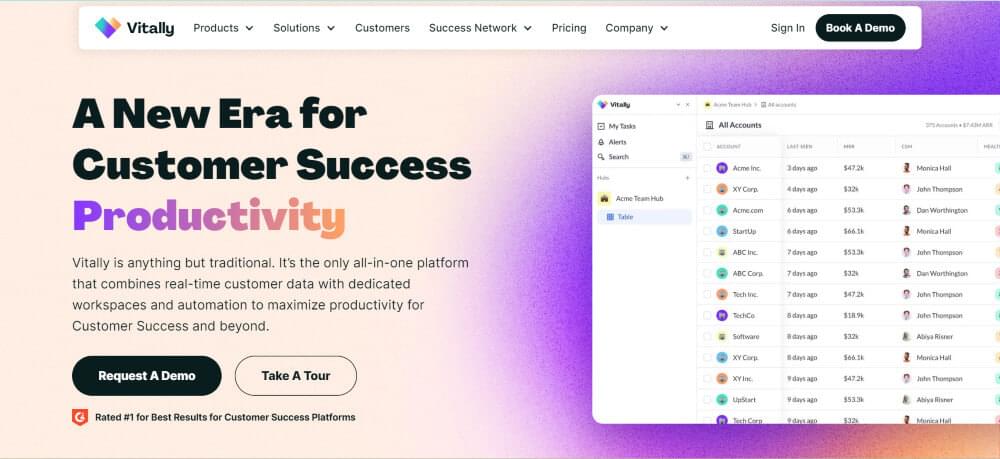
Vitally is a customer success platform popular with scaling B2B SaaS companies. It predicts churn mainly through Dynamic Health Scores, which can change weights by lifecycle stage or segment, so a new customer in onboarding is not judged like a three-year account. Vitally AI summarizes accounts from notes and call transcripts and suggests follow-up actions.
Vitally also includes project management, docs and automations, so CSMs can run onboarding and renewal work in the same place as the health score.
Pros
- Health scores adapt by lifecycle stage and segment.
- Modern interface that CSMs tend to adopt quickly.
- Unlimited automations and observer seats on every plan.
Cons
- Health scoring is rule-driven; there is no dedicated ML churn model advertised.
- Initial setup and data mapping take time.
- No public pricing.
Pricing
Custom pricing. The Vitally pricing page lists Tech-Touch, Hybrid-Touch and High-Touch plans, all with “Request Pricing.” After a demo, Vitally offers a trial sandbox with your own customer data.
8. Planhat
Planhat positions itself as a customer platform that covers CRM, customer success and professional services in one system. Its health scores combine analytics with input from people and AI to show whether customers are thriving or failing, and it stores time-series usage data alongside CRM records, emails and call transcripts. Planhat’s AI agents automate work across the customer lifecycle.
Pros
- One platform for sales, CS and services, so churn risk is visible to everyone who touches the account.
- Strong data model with time-series usage data.
- Flexible dashboards and custom objects.
Cons
- The breadth means more setup and more decisions up front.
- Better suited to B2B companies with defined account teams than to self-serve products.
- No public pricing.
Pricing
Custom pricing. The Planhat pricing page asks you to “Enquire” for a quote.
9. Custify
Custify is a customer success platform aimed at SMB and mid-market B2B SaaS. You build personalized health scores, set custom alerts that go to Slack or email, and trigger playbooks when a score drops. CustifyAI adds churn risk analysis, playbook suggestions and account summaries. Custify also runs a four-week concierge onboarding to get you live.
Pros
- Faster to implement than enterprise CS platforms, with guided onboarding.
- No setup fees.
- GDPR compliant and ISO 27001 certified.
Cons
- Fewer advanced forecasting features than Gainsight or ChurnZero.
- Churn risk depends mainly on the health score rules you define.
- No public pricing.
Pricing
Custom pricing. The Custify pricing page shows a “Get a custom quote” form and states there are no setup fees.
10. HubSpot Service Hub
If your customer data already lives in HubSpot, its Customer Success workspace in Service Hub may be enough to start. You define a health score from contact, company or event properties, for example subtracting points for open tickets or low NPS, and HubSpot labels each customer as healthy, neutral or at risk. Alerts fire when a customer’s health status changes, and CSMs work their accounts from one workspace.
Pros
- No new tool or data sync if you already use HubSpot CRM.
- Health scores connect to HubSpot tickets, surveys and workflows.
- Public pricing.
Cons
- Health scores are rule-based; you set the weights yourself.
- The workspace requires paid Service Hub seats plus a one-time onboarding fee.
- Less depth than a dedicated CS platform.
Pricing
The HubSpot Service Hub pricing page lists Service Hub Professional from $90 per seat per month, plus a required one-time $1,500 onboarding fee. Enterprise starts at $150 per seat per month plus a $3,500 onboarding fee. Both include the Customer Success workspace and up to 50 health scores. HubSpot’s free tools do not include the workspace.
How to Choose Churn Prediction Software
Start with three questions:
- Who will act on the prediction? If you have CSMs who own accounts, pick a customer success platform (ChurnZero, Gainsight, Vitally, Planhat, Custify or HubSpot). If marketing handles retention, look at Optimove or Pecan AI. If nobody has time for outreach, put your effort into the cancellation moment with Churnfree.
- How much churn history do you have? ML models need enough past churners to learn from. If you only have a small customer base, a well-designed customer health score is usually more practical than a model trained on too little data.
- Where does your churn happen? If customers leave because cards fail, you need dunning management, not prediction. If they click cancel after a quiet month, a cancel flow with a pause option often saves them. If big accounts slowly disengage before renewal, invest in health scores and CSM playbooks.
Before signing an annual contract, ask each vendor to backtest the score on your own data: take customers from six months ago, score them, and check whether the “at risk” group actually churned more.
FAQs
What is churn prediction software?
Churn prediction software analyzes customer data such as product usage, billing, support tickets and survey responses to score how likely each customer is to cancel. It then alerts your team or triggers an action, like a CSM task, an email campaign or a retention offer, so you can intervene before the customer leaves.
What is the difference between a health score and a churn prediction model?
A health score is a set of rules you define, for example points for logins and deductions for open tickets. A churn prediction model is trained on customers who already churned and learns the patterns on its own, giving a probability of churn. Health scores are easier to explain and set up; ML models can find patterns you did not think of but need more data.
How accurate is churn prediction software?
Accuracy depends on your data more than the tool. With clean usage, billing and support data and a solid history of past churners, models can rank customers by risk well. With sparse data, predictions are noisy. Judge a tool by backtesting on your own customers: the at-risk group should churn at a clearly higher rate than the healthy group.
Is there free churn prediction software?
Few dedicated tools are free. HubSpot has free CRM tools, but its health scores need paid Service Hub seats, and Pendo Free does not include Predict. Churnfree offers a 14-day free trial with no credit card. Teams with data skills can also build a basic model in Python with scikit-learn on their own data.
Can churn prediction software prevent churn on its own?
No. Prediction tells you who is at risk; your team or your product still has to respond. The most effective setups combine early warning (health scores or ML models), proactive outreach, and a cancellation flow that offers the right alternative when a customer decides to leave.
Conclusion
The best churn prediction software is the one your team will act on. B2B companies with customer success teams will get the most from ChurnZero, Gainsight, Vitally, Planhat, Custify or HubSpot. Teams that want a real ML model on their own data should look at Pecan AI or, if they already use Pendo, Pendo Predict. Consumer brands with large customer bases are best served by Optimove.
Whatever you choose for prediction, some customers will still reach the cancel button. Try Churnfree free for 14 days to turn that moment into a save with a cancellation flow, targeted offers, pause options and feedback that shows you why customers really leave.