



Is Net Sales the Same as Revenue? No, Here Is the Difference

No. Net sales are gross sales minus returns, allowances and discounts. Revenue, or total revenue, is broader: it is net sales plus other income the business earns, such as fees, royalties or interest. For a company that earns almost everything from selling its product, the two numbers are nearly identical, which is why the terms get mixed up.
| Gross sales | Net sales | Total revenue | |
|---|---|---|---|
| What it counts | Every sale at full price | Sales after deductions | All income the business earns |
| Formula | Units sold x price | Gross sales minus returns, allowances and discounts | Net sales plus other income |
| Returns, allowances and discounts | Not deducted | Deducted | Deducted |
| Other income (fees, royalties, interest) | No | No | Yes |
| Where you see it | Internal sales reports | Top line of most income statements | Top line when a company has several income streams |
| Worked example below | $120,000 | $100,000 | $104,000 |
Table of Contents
- Quick Definitions: Gross Sales, Net Sales and Revenue
- Worked Example: From Gross Sales to Total Revenue
- Is Net Sales the Same as Revenue on an Income Statement?
- When to Use Revenue and When to Use Net Sales
- Net Sales vs Net Revenue vs Net Income
- Is Sales the Same as Revenue?
- Balancing Net Sales and Revenue
- Over to You
- FAQs
Quick Definitions: Gross Sales, Net Sales and Revenue
Gross sales
Gross sales are the full value of everything you sold in a period, before anything is taken off. The quick way to estimate it is units sold multiplied by the list price. For a deeper look, see our guide on what gross sales are.
Net sales
Net sales are what is left of gross sales after three deductions:
- Returns: money refunded for products sent back or subscriptions cancelled inside a refund window.
- Allowances: partial credits a customer accepts instead of a full refund, such as a credit for a damaged item or a service outage.
- Discounts: price reductions such as promo codes, early payment discounts or annual prepay discounts.
Net sales = Gross sales - Returns - Allowances - Discounts

Net sales count only income from selling your goods or services. For a SaaS company, this is where refunds on cancelled subscriptions and retention discounts show up. Our full guide to the net sales formula walks through each deduction.
Revenue (total revenue)
Revenue is the total income a business earns in a period, often called the top line. It starts with net sales and adds any other income the business earns, such as licensing fees, royalties, commissions or interest. Many companies show interest and similar items further down the income statement as non-operating income rather than in the revenue line, so check how a given statement is laid out before you compare two companies.
Total revenue = Net sales + Other income
Related read: Gross sales vs net sales
Worked Example: From Gross Sales to Total Revenue
Here is a simple, made-up example for a SaaS company over one quarter.
| Line | Amount |
|---|---|
| Gross sales (subscriptions invoiced at list price) | $120,000 |
| Minus returns (refunds on cancelled subscriptions) | -$6,000 |
| Minus allowances (service credits after an outage) | -$2,000 |
| Minus discounts (annual prepay and promo codes) | -$12,000 |
| Net sales | $100,000 |
| Plus licensing income from a white-label partner | +$3,000 |
| Plus interest earned on cash in the bank | +$1,000 |
| Total revenue | $104,000 |
Step by step:
- Add up the deductions: $6,000 + $2,000 + $12,000 = $20,000.
- Subtract them from gross sales: $120,000 - $20,000 = $100,000 net sales.
- Add other income: $100,000 + $3,000 + $1,000 = $104,000 total revenue.
So in this example net sales and total revenue differ by $4,000, the income that did not come from selling subscriptions. If the company had no other income, net sales and total revenue would be the same $100,000. The gap between gross and net sales ($20,000) is the more useful number to watch, because it shows how much refunds, credits and discounts cost you.
Is Net Sales the Same as Revenue on an Income Statement?
Often the top line of an income statement is labelled “net sales”, “sales” or “revenue”, and in each case it usually means the same thing: sales after returns, allowances and discounts. Apple, for example, labels its top line “Total net sales” in its quarterly and annual SEC filings.
The two numbers only differ when a company earns meaningful income that does not come from its main sales. In that case the statement may show net sales first, then other revenue, then total revenue. So the answer depends on the business:
- Mostly one income stream (most SaaS and retail businesses): net sales and revenue are close to or exactly the same number.
- Several income streams (licensing, royalties, rental or interest income reported as revenue): total revenue is higher than net sales.
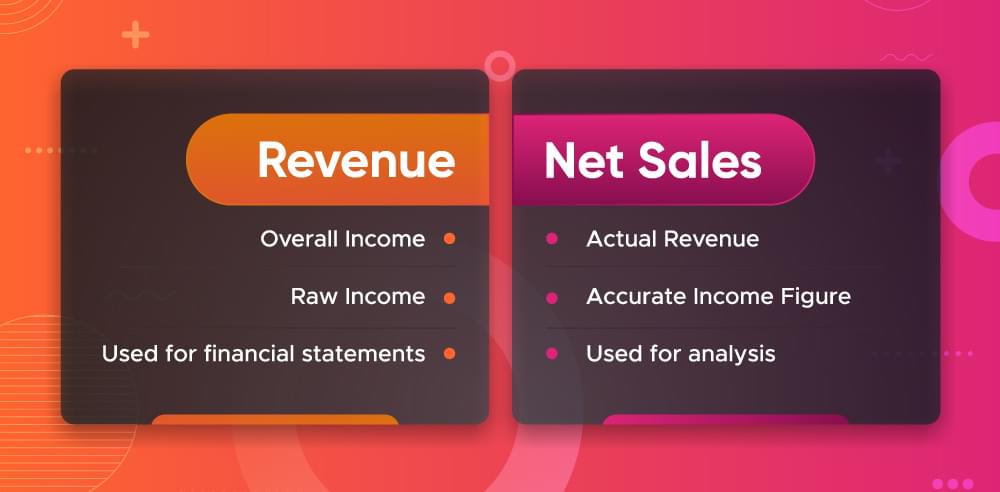
When to Use Revenue and When to Use Net Sales
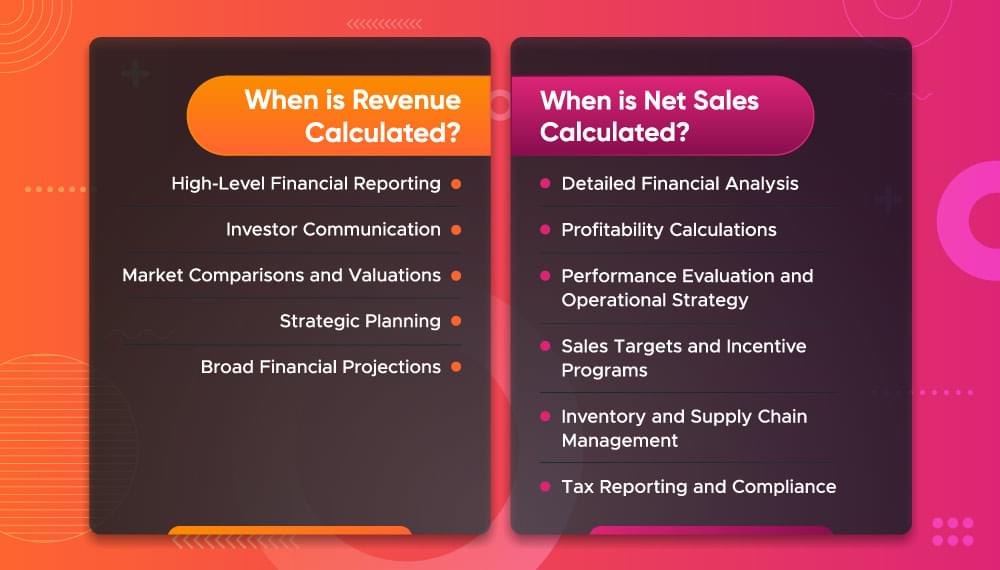
When is revenue used?
- High-level financial reporting: revenue is the top line of the income statement and the figure most people quote when they talk about the size of a business.
- Investor updates: investors and stakeholders usually see total revenue first, because it shows everything the business brings in.
- Market comparisons: comparing your revenue with competitors gives a rough picture of market share and demand.
- Strategic planning: revenue trends help you plan pricing, marketing and hiring at a high level.
When is net sales used?
- Detailed financial analysis: net sales show what your core sales really brought in, so they are the base for most margin analysis.
- Calculating profit: gross profit is net sales minus cost of goods sold (COGS), and gross margin is gross profit divided by net sales.
- Sales targets: measuring a sales team on net sales rather than gross sales rewards deals that stick, not deals that get refunded or heavily discounted.
- Inventory and supply chain: in retail and manufacturing, net sales trends show real demand once returns are removed.
- Spotting leaks: a growing gap between gross and net sales points to rising refunds, credits or discounts that need a closer look.
Net Sales vs Net Revenue vs Net Income
These three terms sound alike but sit at different points on the income statement.
| Term | What it is | Formula |
|---|---|---|
| Net sales | Sales income after deductions | Gross sales - returns - allowances - discounts |
| Net revenue | All revenue after deductions. For a single-product business, usually the same as net sales | Net sales + other revenue |
| Net income | The bottom line: profit after every cost | Revenue - COGS - operating expenses - interest - taxes |
Is net sales the same as net income? No. Net sales sit at the top of the income statement. Net income sits at the bottom, after you subtract the cost of goods sold, operating expenses, interest and taxes. A company can have high net sales and still report a loss.
Is net sales the same as net profit? No, for the same reason. Net profit is another name for net income.
Is Sales the Same as Revenue?
Not always. “Sales” means income from selling your goods or services. “Revenue” covers that plus any other income. When people say “sales revenue”, they usually mean net sales. When they say “total revenue”, they mean everything.
In everyday use, and for a business with one main product, sales and revenue are often used interchangeably. In financial statements, check which one a line actually refers to.
Balancing Net Sales and Revenue
Tracking only revenue can make a business look healthier than it is, because it hides how much you give back in refunds, credits and discounts. Tracking only net sales can hide other income streams that matter to the business.
Watch two things:
- The gap between gross and net sales. If it grows faster than sales, refunds, credits or discounts are eating into your sales. In a subscription business this often traces back to cancellations inside the refund window or to discounts handed out to stop customers from leaving.
- The share of revenue that is not from sales. If most of your revenue comes from other income, your core product may be weaker than the top line suggests.
Having the right structure is just as important as tracking revenue and net sales. Many businesses choose an LLC for liability protection and tax benefits. LLC formation services help handle the paperwork, making the process simple. Setting up your business the right way from the start can help you stay organized and focus on growth.
Are refunds and cancellations shrinking your net sales? Churnfree shows customers who click cancel a cancellation flow with a pause option or a tailored offer, and records why they are leaving, so fewer subscriptions turn into refunds. Start your free trial, no credit card required.
Over to You
Net sales, sales revenue and total revenue are close cousins, and for many businesses they land on the same number. The difference matters when you have income outside your main product, and the gap between gross and net sales tells you how much refunds, credits and discounts are costing you.
For more articles like these, head to the Churnfree blog. A few related reads:
- Net sales formula and examples
- What is gross sales?
- Gross sales vs net sales
- Net revenue retention
- Gross vs net retention
- Benefits of monthly recurring revenue (MRR)
- Churn rate vs retention rate
- Negative churn
FAQs
Is revenue the same as net sales?
Not exactly. Net sales are gross sales minus returns, allowances and discounts. Revenue is net sales plus any other income, such as fees, royalties or interest. If a business earns nothing outside its main sales, the two numbers are the same.
Is total revenue the same as net sales?
No. Total revenue includes net sales plus every other income stream the business reports as revenue. Net sales are only one part of total revenue.
Is net revenue the same as net sales?
Often, but not always. For a company with one main product, net revenue and net sales are usually the same number. If the company also earns licensing, royalty or other revenue, net revenue is higher.
Is net sales the same as sales revenue?
Usually yes. “Sales revenue” normally means income from sales after returns, allowances and discounts, which is net sales.
Is net sales the same as net income?
No. Net sales are at the top of the income statement. Net income is at the bottom, after subtracting cost of goods sold, operating expenses, interest and taxes.
What is the difference between net sales and net profit?
Net sales measure what you sold after deductions. Net profit, or net income, is what is left after every cost of running the business has been paid.
Are sales and revenue the same?
In everyday use they are often treated as the same. Strictly, sales are income from selling goods or services, while revenue can also include other income such as fees or interest.
What is the difference between net sales and gross sales?
Gross sales are the full value of all sales before deductions. Net sales are gross sales minus returns, allowances and discounts. In the worked example above, $120,000 of gross sales becomes $100,000 of net sales.